
Knowledge base
Resources
Practical articles on recovery, product selection, and the ordering process — for patients and clinics, organized in three sections.
 7 articles
Implants and expanders
Choosing shape, volume, and projection; MESMO® and POLYsmoooth™ surfaces and B-Lite® lightweight gel; certificates, serial numbers, and post-operative follow-up.
Go to section →
 5 articles
Surgical sutures and meshes
USP sizes, absorbable and non-absorbable materials, needle types and curvature, hernia mesh selection and fixation.
Go to section →
 5 articles
Compression garments
Size selection, recovery stages I and II (with video guides), garment care, lipedema and scar care.
Go to section →
Most read


How is a compression garment chosen, and when is it worn?
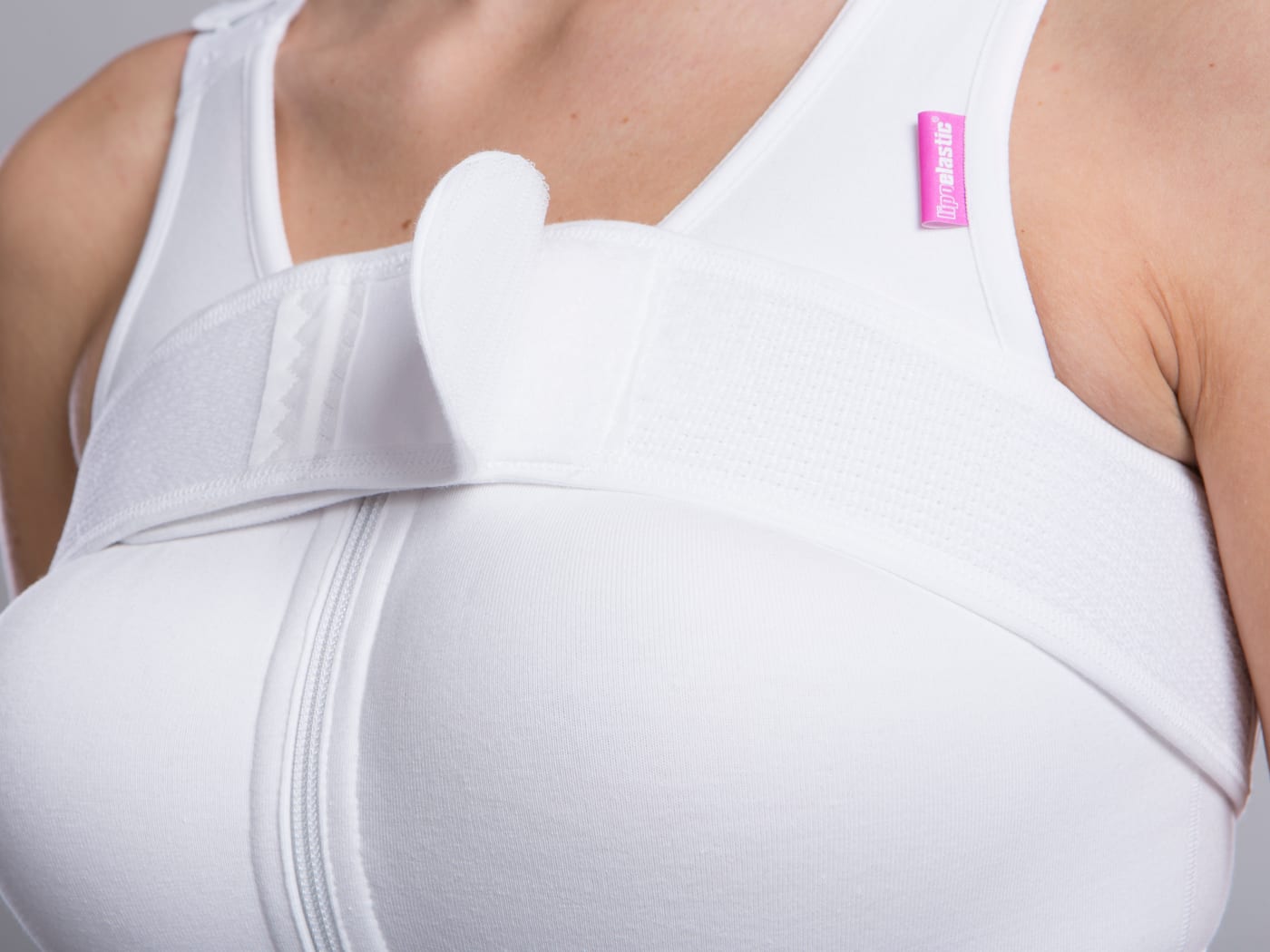
A post-operative compression garment reduces swelling, stabilises the tissues and improves scar formation. Two stages are usually distinguished: Stage I (the first weeks) — stronger compression, worn continuously; Stage II (once the tissues have settled) — light compression, everyday wear. The LIPOELASTIC range has models for each stage.
The right size is fundamental: the garment should fit closely without causing pain, numbness or redness. Choose the size before surgery on your doctor’s advice — size and colour options for each model are found in the catalogue through the filters. How many weeks, and how many hours a day, is for the doctor to decide.
Implant shapes: round or anatomical?
Round implants — the most widely used shape: it gives a fuller upper pole, creates no rotation problems and is technically simpler to place. It is often preferred in aesthetic augmentation.
Anatomical (teardrop) implants — they follow the natural breast silhouette: more volume in the lower pole and a soft transition above. In slim patients with little tissue, and in reconstruction, they can give a more natural result; in exchange they require precise pocket formation. POLYTECH offers both shapes in a range of profiles (projections) — which shape suits whom is the surgeon’s individual decision.
Who are B-Lite® lightweight implants for?
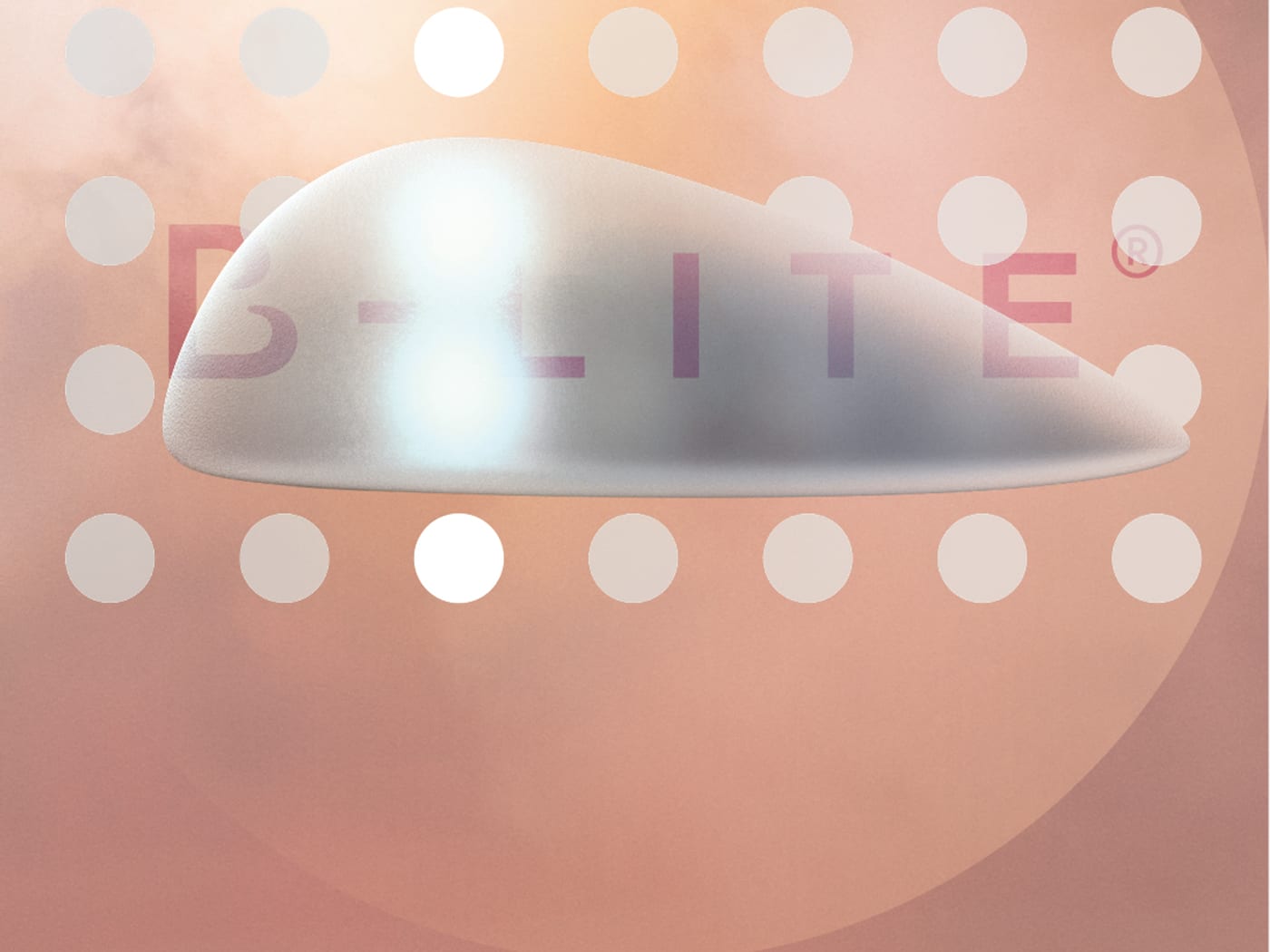
B-Lite® are premium implants that are up to 30% lighter than conventional silicone implants. The lower weight reduces the long-term load on the tissues and skin — which in turn helps reduce the risk of ptosis over time.
Cases worth considering in particular: large volumes (where the weight difference is more noticeable), an active lifestyle and sport, tissue weakness or repeat surgery, and patients for whom the long-term result matters especially. This is a premium-segment product — when discussing the price difference with a patient, the arguments about weight and long-term outcome carry the most weight. The final choice is always the surgeon’s.
Which suture is used for what?
Polyglactin 910 (PETCRYL 910) — the most widely used absorbable suture in the world: braided, with medium-term absorption. A universal choice for soft-tissue approximation, gynaecology, abdominal surgery, and muscle and subcutaneous closure. Rapid version (rapid-absorbing) is used for mucosal and skin closure — where removing sutures would be undesirable.
Polydioxanone (PDO) (DURACRYL) — monofilament with long-term absorption: for tissues needing lasting support, such as fascia and the abdominal wall. Polypropylene — non-absorbable, permanent support: hernia repair, vascular anastomoses. Silk — the classic tying and ligature suture. DURABARB (barbed, knotless) — a continuous suture line needing no knots: it saves time in laparoscopic and plastic surgery.
Choosing a needle: type, size and curvature
Cutting / reverse cutting needles are for skin and dense tissue (reverse cutting reduces the risk of the edges tearing). Taper point needles pass through soft tissue — bowel, vessels, muscle — with minimal trauma. Blunt needles are used on parenchymatous organs (liver, kidney) and to reduce the risk of needlestick injury. Taper-cut combined shapes work at transitions between dense and soft tissue.
The general rule: fine tissue → fine suture (4-0–6-0) and a small needle; for fascia and skin, 0–2-0 and larger needles. Curvature: 3/8 circle — comfortable for superficial closure; 1/2 circle — in deep and narrow spaces. The catalogue filters work on exactly these parameters: material, suture size, needle type, needle length and curvature.
How do ordering, OTP confirmation, review and temporary keeping work?
Place your order on the site or through our sales representative. A one-time code (OTP) is sent to your phone by SMS for confirmation — entering the code confirms the order. On the confirmation page, professional customers choose «pay now» or «temporary keeping / pay later» for each item; a delivery act is drawn up for items taken into temporary keeping, used items are paid against an invoice, and the rest are returned within 2 months. All documents are kept in your personal account.
Still have questions?
Our team can help you with product selection and orders — write to us and we'll get back to you.
Contact us →